
Chinese President Xi Jinping addressed the BRICS summit, urging the bloc to play a significant role in achieving peace and tranquillity in West Asia and the Gulf region. He highlighted BRICS' growth over two decades, its efforts in tackling global challenges, and its steadfastness in safeguarding the interests of the Global South. Xi called for opposing the Cold War mentality, strengthening multilateralism, and promoting cooperation in emerging domains like AI, as China prepares to chair the next summit.

From four nations to a powerful 11-member bloc, here's how BRICS reshaped the global order in 27 years.

The BRICS summit in New Delhi brings together leaders from major emerging economies to address global challenges like trade disputes, geopolitical upheavals, and the economic impact of conflicts in Ukraine and West Asia. India, as chair, aims to position BRICS as an economic growth engine, focusing on the Global South's food, energy, and supply chain security. The summit also highlights the grouping's expansion and its growing influence in global governance.

Heavy rainfall caused significant waterlogging in New Delhi, particularly near IGI Airport, just days before the BRICS Summit. The incident highlighted coordination issues among various city agencies, with PWD officials attributing some flooding to other departments, despite a recent review meeting by the Lieutenant Governor to ensure inter-agency synergy.

For India, the goal is not simply to host another grand diplomatic gathering. It is to prove that a diverse coalition of emerging powers can still deliver.

Prime Minister Narendra Modi, addressing the BRICS summit, called for a fundamental shift in global governance, advocating for the replacement of the current 'pyramid of privilege' with a 'platform of partnership' where the Global South becomes a 'rule shaper' rather than a 'rule follower'.

Indian and Chinese armies held their first high-level commanders' flag talks in the Arunachal Pradesh sector, following Special Representatives dialogue. These talks, aimed at maintaining peace along the Line of Actual Control, occurred amidst reports of aggressive military posturing and just days before Chinese President Xi Jinping's visit to India for the BRICS summit.

Instead, Chinese Premier and Xi's confidant Li Qiang will take part in the summit to be held on July 6-7 in which Prime Minister Narendra Modi was expected to take part.

New Delhi is under a thick blanket of security as it hosts top world leaders for the BRICS Summit. Extensive security measures, including thousands of personnel and CCTV cameras, are in place. Commuters can expect temporary traffic restrictions and diversions due to VVIP movements, though officials aim to minimise public inconvenience.

The 18th BRICS Summit got underway in New Delhi with leaders of partner countries gathering in the capital to discuss the changing global economic and geopolitical landscape.

India and China are in what experts call 'a cooperation-versus-competition situation'.

Chinese Foreign Minister Wang Yi stated that President Xi Jinping and Prime Minister Narendra Modi reached a crucial consensus during the BRICS summit, agreeing that China and India should be partners, not rivals. The leaders pledged to maintain peace and tranquility in border areas, deepen cooperation, and support each other in multilateral forums, aiming to strengthen the Global South and promote a multipolar world order.

Iranian Foreign Minister Abbas Araghchi is in India for a BRICS foreign ministers' meeting, where discussions will focus on the escalating crisis in West Asia and its impact on global energy supply chains.

Iranian President Masoud Pezeshkian urged BRICS nations to expand trade in national currencies and build an inclusive global economic framework. He criticised "unilateral sanctions" by Western powers, stating they make emerging economies vulnerable and impact global food security. Pezeshkian emphasised BRICS' role in creating a balanced world order and highlighted Iran's geopolitical and energy capacities for cooperation.

Ravi Shastri lauded Prime Minister Narendra Modi for taking a leading role in international diplomacy during the ongoing BRICS Summit in New Delhi.

China emphasises proper handling of differences and a long-term perspective for bilateral ties ahead of President Xi Jinping's visit to India for the BRICS summit and talks with Prime Minister Narendra Modi. The visit aims to stabilise relations following the 2020 Ladakh standoff and strengthen BRICS cooperation.

South African President Cyril Ramaphosa on Friday described BRICS as an important global forum, highlighting the grouping's growing demographic and economic weight and noting that its members account for around half of the world's population and 40 percent of global GDP.

The Delhi and District Cricket Association (DDCA) has confirmed that the first T20I between India and Afghanistan will proceed as scheduled on September 13 at the Arun Jaitley Stadium, despite earlier requests from Delhi Traffic Police to reschedule due to the high-profile BRICS Summit.

On Saturday, on the sidelines of the BRICS Summit 2026, Prime Minister Narendra Modi and other leaders participated in a tree plantation on the lawns of Bharat Mandapam in New Delhi.

The BRICS grouping has fully endorsed India's demand for zero-tolerance against terrorism and rejected double standards in combating the menace. Their declaration condemned terror attacks in Jammu and Kashmir and reaffirmed commitment to holding terrorists accountable under international law.

Chinese President Xi Jinping is in New Delhi for the 18th BRICS Summit, where he is scheduled to hold bilateral talks with Prime Minister Narendra Modi. This visit, his first to India in nearly seven years, comes amidst efforts to normalise India-China relations following the 2020 Eastern Ladakh standoff and is expected to have significant implications for bilateral ties and BRICS cooperation.

India's proposal to link BRICS payment systems, including central-bank digital currencies (CBDCs), was notably absent from the grouping's New Delhi Declaration, despite being a key agenda item for India's chairmanship. This omission leaves the 16-year effort for trade in local currencies without a settled payment architecture, with the declaration only 'acknowledging' the work of the BRICS Payment Task Force.

National Security Advisor Ajit Doval engaged in Special Representatives talks with Chinese Foreign Minister Wang Yi in Beijing, focusing on the India-China boundary question and enhancing bilateral relations. These crucial discussions precede Chinese President Xi Jinping's anticipated visit to New Delhi for the BRICS summit, aiming to address persistent border differences and stabilise ties strained by past conflicts like the Galwan Valley clash.
China's foreign ministry on Monday parried questions on a possible meeting between Prime Minister Narendra Modi and President Xi Jinping on the sidelines of the BRICS summit in Russia this week.

The Congress party, through leader Jairam Ramesh, took a veiled swipe at Prime Minister Narendra Modi by invoking a Bollywood song and sharing Jawaharlal Nehru's notes from the 1955 Bandung Conference. This move came after the BRICS Delhi Declaration referenced the Bandung Conference, which advocated for a fairer and more inclusive multilateral system, amidst Modi's frequent criticism of Nehru.

India supports dialogue and diplomacy and not war, Prime Minister Narendra Modi said at the Brazil, Russia, India, China, South Africa (BRICS) Summit in Kazan, Russia on Wednesday, in an unambiguous message calling for resolution of the Russia-Ukraine conflict through peaceful negotiations.

'We are open to all countries around the world as long as we get a fair deal, as long as we are ensured continuity in the engagement.'

From his first summit appearance in Durban in 2013 to the bloc's landmark expansion and renewed diplomacy in recent years, Xi Jinping's speeches and initiatives have reflected China's evolving priorities within BRICS.

Senior Congress leader Shashi Tharoor has articulated India's position on BRICS, advocating for it to be a "non-West, but not anti-West" platform, a stance he believes is crucial for India's national interest. He highlighted the prestige of hosting the BRICS summit, India's responsibility to represent the Global South, and the significance of bilateral meetings, particularly with China and Russia. Tharoor also addressed the strained India-China relations, citing border issues and trade leverage, and discussed the challenges within BRICS, including difficulties in achieving consensus on global issues and trade imbalances, while also considering the need for diversified international relations amidst unpredictable US sanctions.

The BRICS grouping adopted a consensus joint declaration in New Delhi, successfully navigating differences on the West Asia conflict but notably omitting any direct mention of US strikes on Iran or Iranian military attacks on Gulf Arab nations. The declaration also criticised Israel's actions in Gaza and called for a concerted approach against terrorism.

The BRICS New Delhi Declaration has endorsed India's proposals for a Working Group on Sports Technology and a Sports Goods Manufacturing Conclave, aiming to enhance cooperation and innovation among member nations in the sports sector.

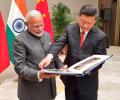
On Saturday, Prime Minister Narendra Modi and Chinese President Xi Jinping met on the sidelines of the BRICS Summit in New Delhi.

Delhi Police have arrested three men from Punjab for allegedly painting pro-Khalistan and anti-BRICS slogans near the Singhu border. The arrests were made at the behest of designated terrorist Gurpatwant Singh Pannun, chief of the banned Sikhs for Justice (SFJ). One of the accused, Preetpal, previously arrested for similar activities, is suspected to be SFJ's operational head in India and is being investigated for foreign funding and links to terror operatives.

Members of the Tibetan community in exile held a symbolic protest march in Delhi's Majnu Ka Tila ahead of Chinese President Xi Jinping's visit to India for the BRICS 2026 Summit, voicing opposition to Beijing's policies in Tibet.
India's total goods trade with BRICS nations more than doubled from FY21 to FY26, reaching USD 417.5 billion, but a significant surge in imports, particularly from China and Russia, has caused India's trade deficit with the bloc to more than triple, reaching USD 226.1 billion.

Maharashtra Chief Minister Devendra Fadnavis on Monday said that the state government has already constituted a committee to prepare the Uniform Civil Code (UCC) and that the law will be implemented after the committee submits its report.

India is currently examining Bangladesh's request for the extradition of former prime minister Sheikh Hasina, who has been living in India since her government's collapse in August 2024, with New Delhi confirming the issue is being processed according to established procedures.

A Kishore Kumar song, a birthday cake, a prince's break from protocol to thank his driver, a Persian painting on the ceiling of the presidential residence -- the BRICS Summit had many memorable moments.

'The Chinese military cannot advance much in Ladakh, even if they want to.' 'Similarly, in Arunachal Pradesh, they can rename a village or two, intrude here or there, but cannot do much more realistically.'
Prime Minister Narendra Modi cautioned against the 'weaponisation' of technology and critical minerals at the BRICS summit, advocating for cooperation to foster shared prosperity. Concurrently, Chinese President Xi Jinping announced plans for an open-source AI ecosystem for BRICS nations, positioning Beijing as a key technology partner amid global AI competition.
